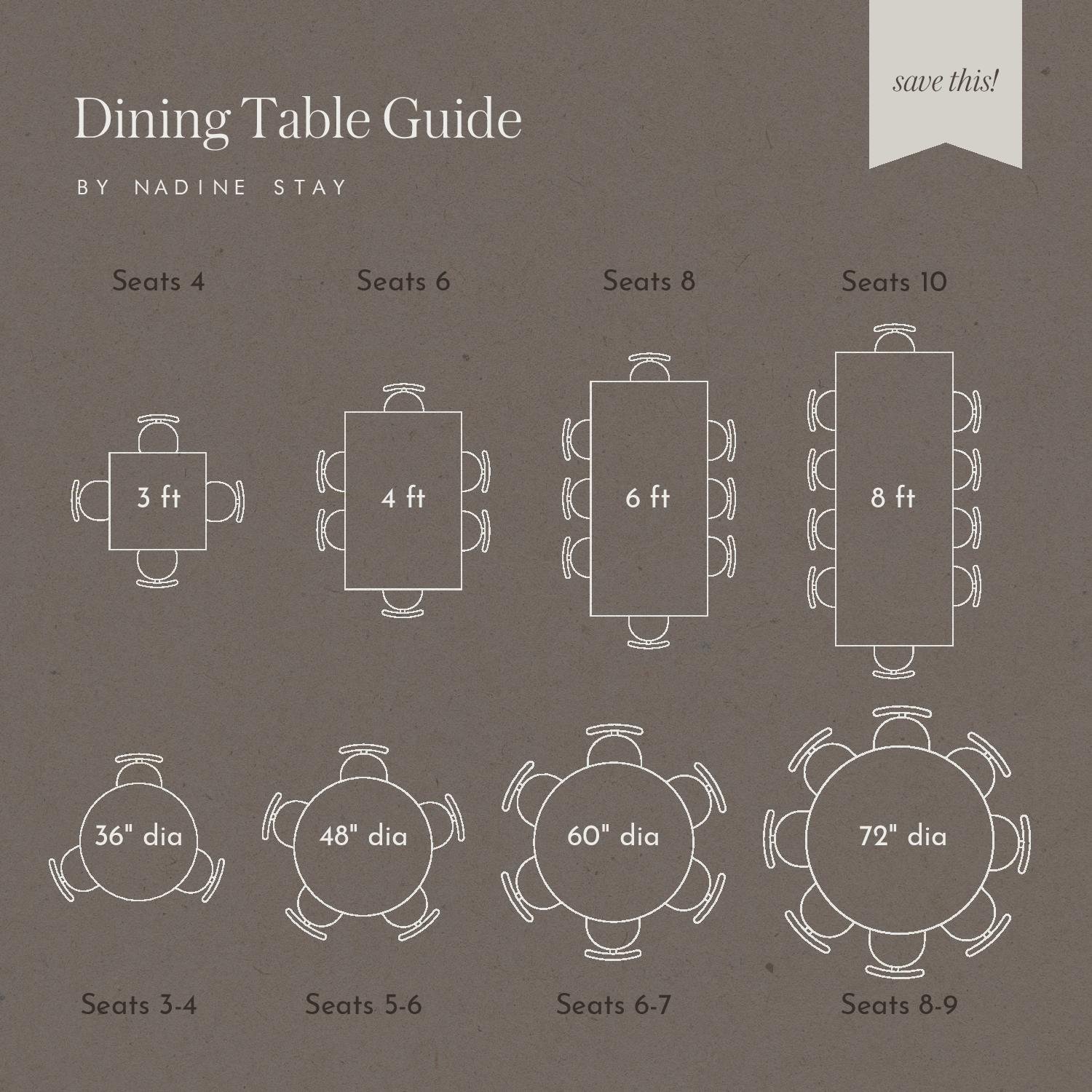

The dining table is the focal point of the dining room, and with it drawing so much attention, it’s important to spend time ensuring you get the right one. Mapping out a size that’s proportionate to the space, determining the number of chairs that will fit, and landing on a suitable shape are the three biggest factors in selecting a dining table. It can feel overwhelming when you’re starting from scratch, but there are some fundamental guidelines that will help you make an informed decision. Today, I’m sharing a dining table size, shape, and seating guide.
This post contains affiliate links.
Dining Table Size Recommendations

To determine what size dining table will fit in the space, you’ll need to do a little measuring. Measure the length and width of the room. If you have any furniture, like a sideboard, measure from that instead of the wall. Now, subtract 6 ft (or 72”) from both the length and width. This is the size of the table that you can fit comfortably in the space.
There should be roughly 36” of space between the dining table and the wall (or any furniture you have in the room) to account for chairs and a walking path.
OPEN CONCEPT DINING ROOMS:
If you have an open concept dining room, map out a dining room zone with painter’s tape. Then subtract 36” from each side to determine a suitable table size.
Determine How Many Chairs Fit (Rectangle Tables)

The general rule of thumb is 2 feet per seat. Take the total table length (in inches) and divide it by 24. This will determine how many chairs you can fit at the table lengthwise. If your table is at least 36” wide, you can add chairs on the ends as well.
KEEP IN MIND:
If your dining chairs have arms, you may need more than 2 ft per seat. Aim for 2-6” of space between chairs.
Also, if your dining table has inset legs, this may affect the number of chairs that fit. You don’t want human legs bumping into the table legs. For the most usable space, pick a dining table with legs that are at the outermost corners.
Determine How Many Chairs Fit (Round Tables)

Generally speaking, round tables can’t seat as many people as rectangular tables. To determine how many chairs can fit at a round table, multiply the table top diameter (in inches) by 3.14. Then divide that number by 24 (for cozy seating) or 30 (for comfortable seating).
NOTE:
24” per seat may be a little snug for round tables, but it’s cozy for family dinners. For hosting or formal dinners, you’ll find that 30” per seat is more comfortable.
Dining Table Shape Recommendations

I like to use the shape of the room as a guide for the shape of the table. A rectangular room looks best with a rectangular table, while a square room looks best with a round table.
For small spaces, like a corner nook, round tables are often best. They create ample walking space along the perimeter without looking too bulky for the space.
KEEP IN MIND:
Dining rooms with multiple functions (i.e. a dining room that also has a door to the backyard) may affect the most suitable shape for the table. For example, this dining room is square, but with the back entry also in the room, the dining area needs to be pushed to the side to accommodate a walkway. The room is then divided into two zones – a dining zone and a walkway zone. With the new dining zone being rectangular, a rectangle table works best.
For a quick recap, save the dining table guide graphics below when you need a refresher. Below, you’ll also find a shopping list with beautiful dining tables in every size and shape!


Dining Tables In Every Size & Shape
SCROLL TO VIEW THE FULL LIST →
Where behind the scenes, exclusive advice, and candid conversations are sent straight to your inbox every week.
The Inside Scoop
DO YOU WANT