
I have not been shy about my love for historic architecture and my distaste for many modern alterations. You’d think that as building techniques advanced and manufacturing became more sophisticated, architectural mouldings would have grown more intricate and refined. But unfortunately, the opposite has happened.
Money, mass production, fast construction timelines, and a shortage of skilled woodworkers have resulted in simplified homes with little to no architectural interest. While this shift can be seen throughout nearly every aspect of design, one often-overlooked detail deserves special attention: moulding profiles.
The evolution of door and window casings, baseboards, and crown moulding is a fascinating story. These seemingly small details play a significant role in why historic homes feel rich, layered, and memorable, while newer homes often feel flat and uninspired. Let’s take a closer look at how trim has evolved and why it’s a topic every homeowner and designer should care about.
The Difference Is In The Depth
The biggest difference between historically accurate Classical casings and today’s iterations is the depth of the profile.

The moulding on the left is a Classically proportionioned door and window casing. It is nearly 1 3⁄4 inches thick and tapers down to 3/4 inch. This thickness allows for deep curves and incisions, which ultimately creates desirable shadow lines.
The two casings on the right are flattened versions of Classical moulding. The middle casing is a “Colonial profile” from a major home improvement store. It attempts to follow the form of Classical proportions, but it misses the mark in several ways. It is only 3/4 inch thick (less than half the thickness of the historic casing), which means that each curve is flattened significantly.
The casing on the far right is even simpler than the middle one. The backband is flattened entirely, the bead is non-existent, and curves have been reduced to nothing. This, unfortunately, is one of the most used casings today.

The same is true of baseboards. The historically proportioned baseboard on the left is thick and allows for deep curves. The right baseboard is thinner with shallow curves and a flattened profile.
Shadow Lines
Shadow lines are created when light interacts with the moulding’s curves. Shadow lines define the profile and convey depth in a way that clearly indicates quality. But this can only be achieved when trim is thick enough to accommodate such deep, intricate details. You can create far more defined shadow lines with 1 3/4 inch wood than you can with the 3/4 inch trim that is standard today.
Beyond just the depth of the trim, the type of incision matters too. 90° incisions create stark shadow lines, while v-groove incisions (which are now standard on MDF and mass-produced trim) produce blurry shadow lines. The difference is easily seen below:

The shadow lines are prominent on the left casing, blurry on the middle, and non-existent on the right casing.
The casing on the left is historically proportioned. The depth of the contour and the 90° incisions create prominent and stark shadow lines that further showcase the intricacy.
The middle casing features rounded curves and v-grooves, as opposed to 90° incisions. As a result, the shadow lines are blurry, and the intricacy is lessened significantly in comparison to its historic counterpart.
The casing on the far right has been reduced to merely 2 shallow v-grooves. Because of this, the shadow lines are nearly absent, and the profile falls flat…literally. It’s a sad interpretation of Classical moulding.

Notice the shadow lines on the bottom baseboard are far more prominent than the top baseboard.
The difference in shadow lines is especially obvious on the baseboards shown above! While the top baseboard has a blurry contour, the bottom one features stark dark lines.
Some Crown Moulding Is Too Busy
While most modern-day trim has been oversimplified, the opposite is also true in some cases. Several manufacturers have attempted to replicate Classical crown proportions, but miss the mark. When too many small beads and coves are carved closely together, they lose their definition.
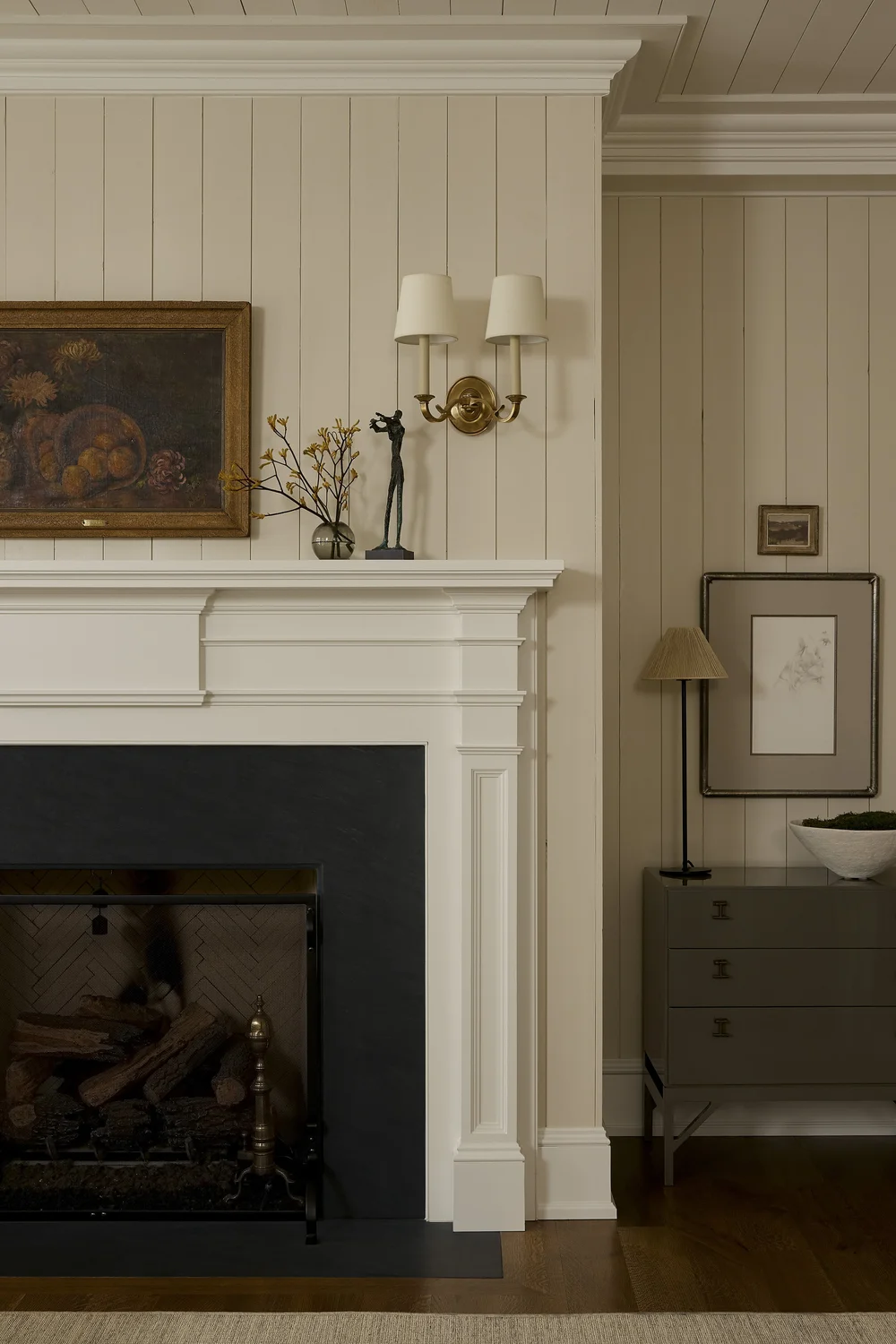
Take the photos below, for example. In our own kitchen, we have crown moulding that features many small beads and incisions. The naked eye can’t differentiate where one curve ends and the next one begins, resulting in a blur. On the other hand, the crown above the fireplace has far more layers, yet each cove and curve is larger, making it easier to read.


Design: J Scott Anderson & W Design Collective
Photography: Malissa Mabey
Where To Buy Historically Accurate Mouldings
There are two manufacturers that make historically accurate mouldings and millwork:
- Kuiken Brothers: A wide selection of mouldings that are divided into architectural styles for easy shopping. Available exclusively through their website. *The Classical mouldings shown in the photos above are from Kuiken Brothers.
- WindsorONE: American-made mouldings. They have a smaller selection, but the quality is great, and their proportions are accurate. Available through their website.
Where behind the scenes, exclusive advice, and candid conversations are sent straight to your inbox every week.
The Inside Scoop
DO YOU WANT