Window Styles for 18 American Architectural Styles (How To Choose The Right Window For Your Home)
·

Windows are the eyes of the home. They can tell us how old a home is and what the architectural style is. Whether you are renovating an old home or building a new one, it’s important to know which type of window is most fitting for the architecture of your home. Choosing the wrong window styles can tell a confusing architectural story, but the right window reinforces the home’s architectural integrity, making the house feel intentional and true to its roots.
Today, I’m breaking down 18 common American architectural styles and the window styles they feature.
SOMETHING TO KEEP IN MIND: As mentioned above, windows can give us information on when a home was built and the style of the home. Unfortunately, many historical windows have been replaced with modern versions, so windows shouldn’t be the sole source of information for dating a home, but it can be a great place to start.
TERMS TO KNOW:
Sash = The framework that holds the glass within the window frame. This is the part that slides, cranks, or tilts open.
Lites = Individual panes of glass within the sash, separated by muntins.
Muntin = A thin strip of wood that holds the glass panes together
9/6 = 9 lites in the upper sash, 6 lites in the lower sash. Various combinations will be mentioned, such as 6/6, 2/2, 6/1, etc
Multi-pane = Multiple lites in a variety of patterns
Single-pane = No muntins
TABLE OF CONTENTS:
- COLONIAL
- ROMANTIC
- VICTORIAN
- ECLECTIC
- MODERN
- PRESENT DAY
Colonial Era
The Colonial era comprises 7 architectural styles – Postmedieval English, Dutch Colonial, French Colonial, Spanish Colonial, Georgian, Federal, and Early Classical Revival. I will cover the most common American styles below.
Dutch Colonial (1625)

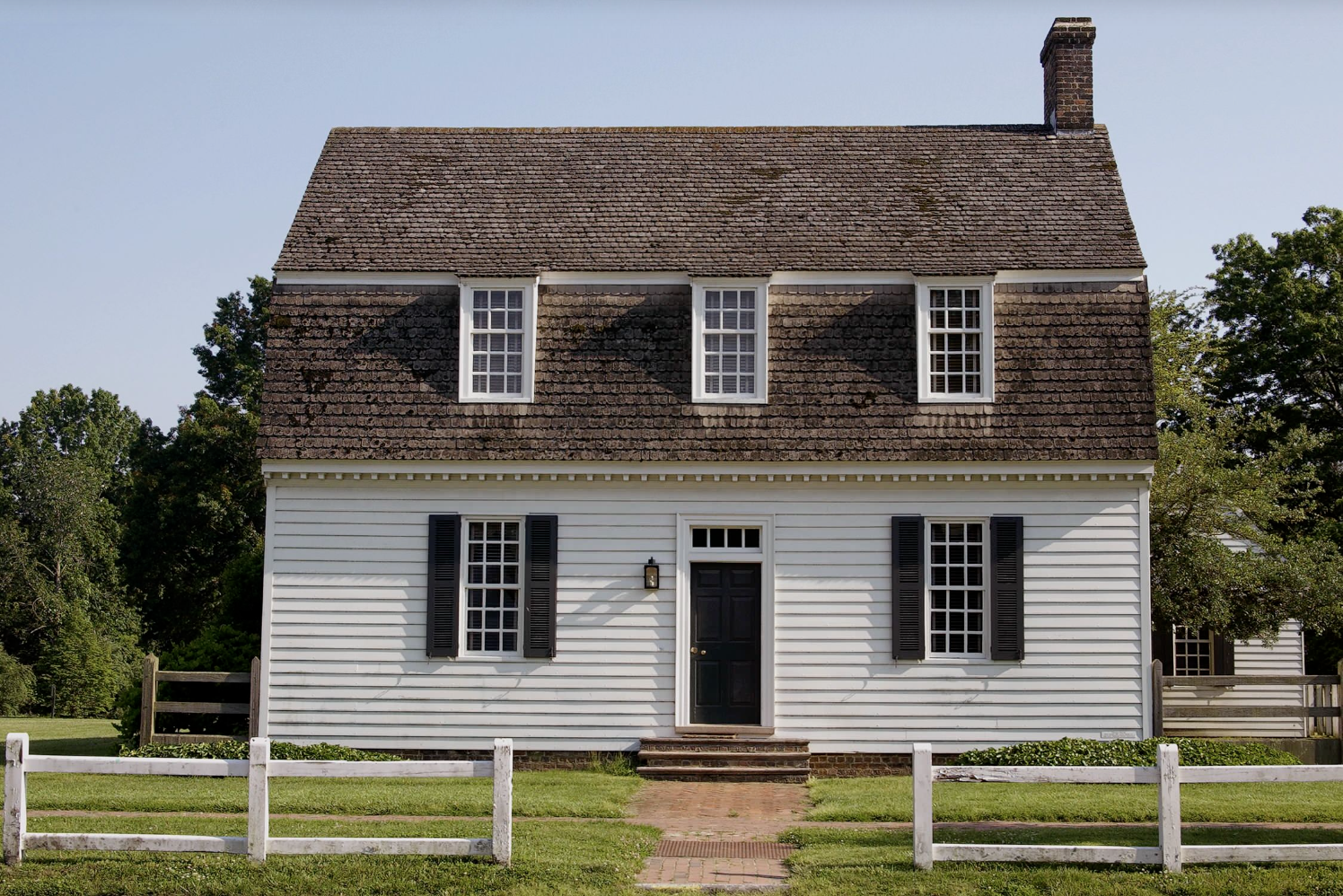
The Ewing House in Colonial Williamsburg
Three styles of windows were used on Dutch Colonial homes. The earliest houses (pre-1700) had leaded casement windows. Then came wooden casement windows. And shortly after (post 1750), wooden double-hung windows with one movable sash were used. Today, we primarily see wooden double-hung windows on Dutch Colonial homes.

Georgian (1700-1780)

Hoar-Hall House | Photo from Buildings Of New England
Georgian homes have double-hung windows with many small panes of glass separated by thick wood muntins. They couldn’t make large sheets of glass at that time, so most panes were around 6″x8″ or smaller. Generally, Georgian windows have 9/9 or 12/12 lites, but 9/6, 6/9, 8/12, and 12/8 were also seen occasionally. The muntins were wide and shallow, generally 1-1 ¼” wide.
Windows are installed symmetrically, both horizontally and vertically. Most homes have a 5-ranked front (5 windows across on the second level, 4 windows & 1 door on the first), but a few are 3 or 7-ranked. Most importantly, Georgian windows are never paired together. They are always standalone windows.

Federal (1780-1820)

Fort Hunter Mansion
Federal homes feature multi-paned double-hung windows. By this period, larger panes of glass could be made, increasing from 6″x8″ to 8″x12″. Because of this, Federal homes generally have larger window panes than Georgian homes. 6/6 double-hung windows are most common. Additionally, the windows were never paired side by side. They were always standalone windows installed symmetrically, both vertically and horizontally.
The muntins also changed ever so slightly from the Georgian era. While Georgian muntins are shallow and wide, Federal muntins are the opposite – narrow and deep. Generally narrower than 1″.
The Palladian window is another common feature of Federal homes. A Palladian window is a set of three windows – an arched central window flanked by two narrow, shorter, rectangular windows. It is often located on the second story, above the front door.
Finally, a fanlight above the front door is a key characteristic of Federal homes. The shape can vary from a semicircle (usually when the fanlight spans over the door only) to an elliptical arch (typically when the fanlight spans over both the door and the sidelights).

Romantic Era
The Romantic era comprised of several styles, most notably Greek Revival, Gothic Revival, and Italianate.
Greek Revival (1825-1860)

Buildings Of New England
Generally, Greek Revival homes featured 6/6 double-hung windows. Small windows, set into the frieze beneath the cornice, were also frequent.

Gothic Revival (1840-1880)

The David Forrest House from Buildings Of New England
2/2 double-hung windows are most common on Gothic Revival homes, although diamond sashes were also present. Most homes have at least one window with Gothic details – a pointed arch, a cluster of two or three arched windows, or a small projecting bay of windows. It’s also not unusual to see faux arches – wood cutouts placed above, or over the top of the window to mimic a pointed arch.

Italianate (1840-1885)

Photo source
Italianate homes feature tall, narrow double-hung windows. They’re commonly arched with 2/2 or 1/1 panes. The shapes of the windows vary; some have a rectangular top, while others have a flattened, segmental, or full arch. It’s also not unusual to see these narrow windows clustered in groups of 2 or 3.

Victorian Era
There were six common architectural styles during the Victorian era: Second Empire, Stick, Queen Anne, Shingle, Richardsonian Romanesque, and Folk Victorian. Several remain common today, which I will cover below.
Second Empire (1855-1885)

The Warren W. Dutcher House via Buildings Of New England
The window styles of Second Empire homes are similar to those of Italianate. They featured 2/2 or 1/1 double-hung windows with rectangular, flattened arches, segmental arches, or full arches. Windows are seen in single, double, and sometimes even triple configurations.

Stick (1860-1890)

Buildings Of New England
Stick homes have 2/2 or 1/1 double-hung windows. In the West Coast, specifically Northern California, Stick houses feature a square-sided bay window.

Queen Anne (1880-1910)

Photo by Jim Witkowski
The Queen Anne style has double-hung windows. While many are simply 1/1, it’s common to see a decorative multi-pane upper sash and a single-pane lower sash. Numerous upper sash design variations can be found in old architecture books, but a clear pane surrounded by small rectangular squares (sometimes stained glass) was perhaps most common.

Shingle (1880-1910)

George P. Lawrence Summer House via Buildings Of New England
Much like Queen Anne, Shingle homes feature double-hung windows with multi-pane upper sashes and single-pane lower sashes. The upper sashes of Shingle homes, however, are far less elaborate – generally 6 or 9 lites. Windows are sometimes paired or grouped in 3 or more.
The Palladian window makes a return during this era, with a multi-pane upper sash and a single pane below. One or two-story bay windows are also seen.

Eclectic Era
During this period, builders drew inspiration from various previous architectural styles. I will cover the two styles we see most frequently today – Colonial Revival and Tudor.
Colonial Revival (1880-1955)

Via Perinton Historical Society
Colonial Revivals draw inspiration from the Colonial era. While window styles of the Colonial era were strict in formation with little variety, Colonial Revival window styles have more variation. Double-hung windows may be 6/6, 8/8, 9/9, or 12/12. Equally as common are multi-pane upper sashes with single-pane lower sashes, such as 6/1, 8/1, 9/1, or 12/1.
Windows are frequently paired or tripled (something you would never see on a Colonial home), and bay windows are also prevalent. More accurately designed homes feature 6/6 or 9/9 standalone windows – like Federal or Georgian homes.

Tudor (1890-1940)

Via Buildings Of New England
The Tudor style draws inspiration from early English building traditions and the American Craftsman house. Original English Tudor homes only had casement windows, but American Tudor homes typically feature a combination of both casement and double-hung windows. Most homes have one or more groupings of casement windows.
Wood muntins are sometimes replaced with thin strips of lead, which hold rectangular or diamond-shaped panes of glass together.

Modern Era
Modern homes come in many forms, and the window forms evolved greatly during this era.
Prairie (1900-1920)

Via Frank Lloyd Wright Trust
Prairie homes have very distinct windows – featuring geometric patterns of small glass panes. Vernacular examples commonly have double-hung windows with upper-sash detailing. Sophisticated examples frequently have casement windows with lead strips.

Craftsman (1905-1930)

Craftsman homes have double-hung windows, often in pairs or groups of three, with multi-pane upper sashes and single-pane lower sashes. A large center window flanked by two narrow windows is common as well.

Ranch (1935-1975)

Via Hirshfield’s
A greater variety of manufactured windows became available during this time, so it’s common to see several window styles and sizes on Ranch homes. In addition to new styles, metal adaptations of casement, double-hung, and sliding windows also became available.
While early architectural styles positioned glass panes vertically, Ranch homes have horizontal panes. A large picture window is a staple of Ranch homes, as are window groupings. Some groupings have tall windows with single panes, while others are short and placed high on the elevation.
Casement and double-hung windows are also common. Some feature multi-pane glass, although most examples today have single-pane windows.

Contemporary (1945-1990)

As the architectural style continued to modernize, windows were simplified and enlarged. Window walls featuring large, thick, and fixed panes of glass became common. Windows extended into the gable ends and just below the roof line, creating connectedness with the outdoors. Most importantly, windows did not feature muntins.

Modern

Much like Contemporary homes, Modern homes feature large, single-pane windows. They are often grouped.

Present Day
Today, Millennium Mansions dominate the architectural world. Subdivisions across the country opt for Millennium Mansions as they allow for large square footage homes on small plots of land.
Millennium Mansion (Late 1980’s to present)

The Millennium Mansion, also called McMansion, features a wide variety of window styles. One home may have multi-paned double-hung windows, casement windows, and arched windows all on the front elevation alone.
Double-hung windows (sometimes paired or tripled, with or without muntins) are very common. Casement windows, also sometimes paired, tripled, or arched, are equally as common. Arched windows may have a full arch or a segmental arch. The Palladian window may appear from time to time as well.
While window styles vary from home to home, one common denominator is a large arched window above the front door. This is meant to highlight the two-story entry.

For a quick reference to all the architectural designs and their window styles, save this graphic below!

References:
- A Field Guide To American Houses by Virginia Savage McAlester
- Western Sash & Door Co Catalogue, published in 1899
- Buildings Of New England
This post contains affiliate links.
Leave a Reply
Where behind the scenes, exclusive advice, and candid conversations are sent straight to your inbox every week.
The Inside Scoop
DO YOU WANT

Love this article, it’s so clarifying! I do have one question though. I’ve lived in South America and in several European countries, and I’ve never really come across guillotine windows. Windows here usually open inward from the sides.
Are guillotine windows practical and easy to use in everyday life? I can definitely see the advantage of them not taking up any interior space when opened, which actually seems very convenient. I’d also love to know whether side-opening windows like the ones we commonly use here are used there as well, or if guillotine windows are the standard in most homes.
Hi Tatjana, Although I’m not an expert on European architecture, casement windows definitely seem to be more popular there than double-hung windows. In America, double-hung windows (which slide up and down) and casement windows (which open outward) are very common and practical.