
If you’ve ever Googled how to install a flagstone path or patio, you’ve likely been met with half a dozen different methods and instructions. The truth is, there are several “right” ways to go about it, but each method has its own set of pros and cons. After installing plenty of flagstone paths and patios ourselves, we’ve tried the different methods, tested their longevity, and put them to use. In this article, I’m breaking down the three flagstone installation methods we’ve done, ranking them, and sharing what we’d absolutely repeat (and what we wouldn’t). This honest comparison will help you choose the best option for your project.
This post contains affiliate links.
Method #1: Small Flagstones With Limestone Chips & Edging


RATING: 6/10
The first flagstone path we created was at the Nebraska House. It’s about 3-4 feet wide and quite long. Since the driveway was gravel, it felt natural to repeat that aesthetic for the path as well. We dug down, installed metal edging nearly flush with the ground, rolled out landscape fabric, poured and packed a limestone chip base, laid the flagstones on top, and filled in the gaps with more limestone chips.
PROS:
- Semi-easy installation.
- Using smaller flagstones makes this a doable DIY project.
- We left wider gaps (roughly 6″) between the flagstones, which meant that we didn’t need to cut/custom fit any stones.
- Getting the flagstones level was easy with a limestone chip base.
- Using limestone chips for the filler is an easy and inexpensive choice.
- Can easily remove or reposition the stones if desired (i.e. if you dislike the color of one, breakage, etc)
CONS:
- The limestone chip base scatters over the flagstones, making it look messy. I did spray pea gravel glue, which helped significantly, but it requires yearly reapplication in the spring.
- The steel edging, while effective at keeping the limestone chips from scattering in the yard, is an eyesore if it sticks up too high. Additionally, you need to be careful not to hit it when mowing.
While I love how the path turned out, I don’t think I would use steel edging again. It’s a little too harsh a line for my liking. Additionally, the upkeep required to keep the limestone chips off the flagstones would become annoying in the long run. If this were in an informal English garden, I wouldn’t mind the unkept look, but for a front path, it felt too messy.
Read more about this flagstone path:
Method #2: Small Flagstones With Dirt & Moss


RATING: 9/10
For the Maine Cape’s front path, I wanted something low profile and natural, as though it had been there for a hundred years. We opted for smaller, locally sourced garden stones and kept the path at about 2 feet wide with staggered edges. The stones are spaced roughly 2-3 inches apart. We dug out where each stone would lie, placed each stone as level as we could, filled the joints with dirt, and later transplanted moss. This created a New England, garden-style, aged-in-place look.
We opted not to pour a gravel base. Generally, a gravel base is recommended to encourage drainage and prevent frost heave (when the rocks are pushed to the surface from freezing and thawing). However, in our area, it’s not wildly uncommon for small paths to not have a gravel base (especially at historic homes). In our case, we weren’t concerned about getting the stones perfectly level. In fact, we wanted them to look slightly imperfect. We opted not to use a gravel base, somewhat as an experiment. In March, as the ground thawed, we definitely noticed some stones were sinking into the ground. But after a couple of weeks, the ground and stones settled back to their original place. Thus far, we have not had any issues. I will report back if that changes.
If you are using smaller flagstones, concerned about frost heave, laying a lot of flagstones, or creating a patio, it would be best practice to pour and pack a gravel base. (Installation would be much like the flagstone path below.)
PROS:
- It’s the most natural-looking
- Using smaller flagstones makes this a doable DIY project.
- We left wider joints (roughly 2-3″) between the flagstones, which meant that we didn’t need to cut/custom fit any stones.
- Can easily remove or reposition the stones if desired (i.e. frost heave, breakage, etc)
CONS:
- While this is absolutely DIY friendly, it is labor-intensive to install. It requires some effort to dig out the spots where the stones will lie.
- A dirt base is not quite as easy to get the stones level as a gravel base. It’s a lot of digging out dirt, adjusting, pouring dirt back in, and repeating.
- Not ideal for a patio. See why below
I love the natural look and staggered edge of this path. Dirt and moss between stones is the ideal choice for a path, in my opinion. Would I do this for a large patio? No, as the stones would be too small and the many gaps would look busy. The scale just wouldn’t look right. Plus, a patio would require a properly packed gravel base to ensure a level surface and longevity. But would I utilize this method again for a path? Absolutely! We have and we will again!
Method #3: Large Flagging With Polymeric Sand


RATING: 10/10
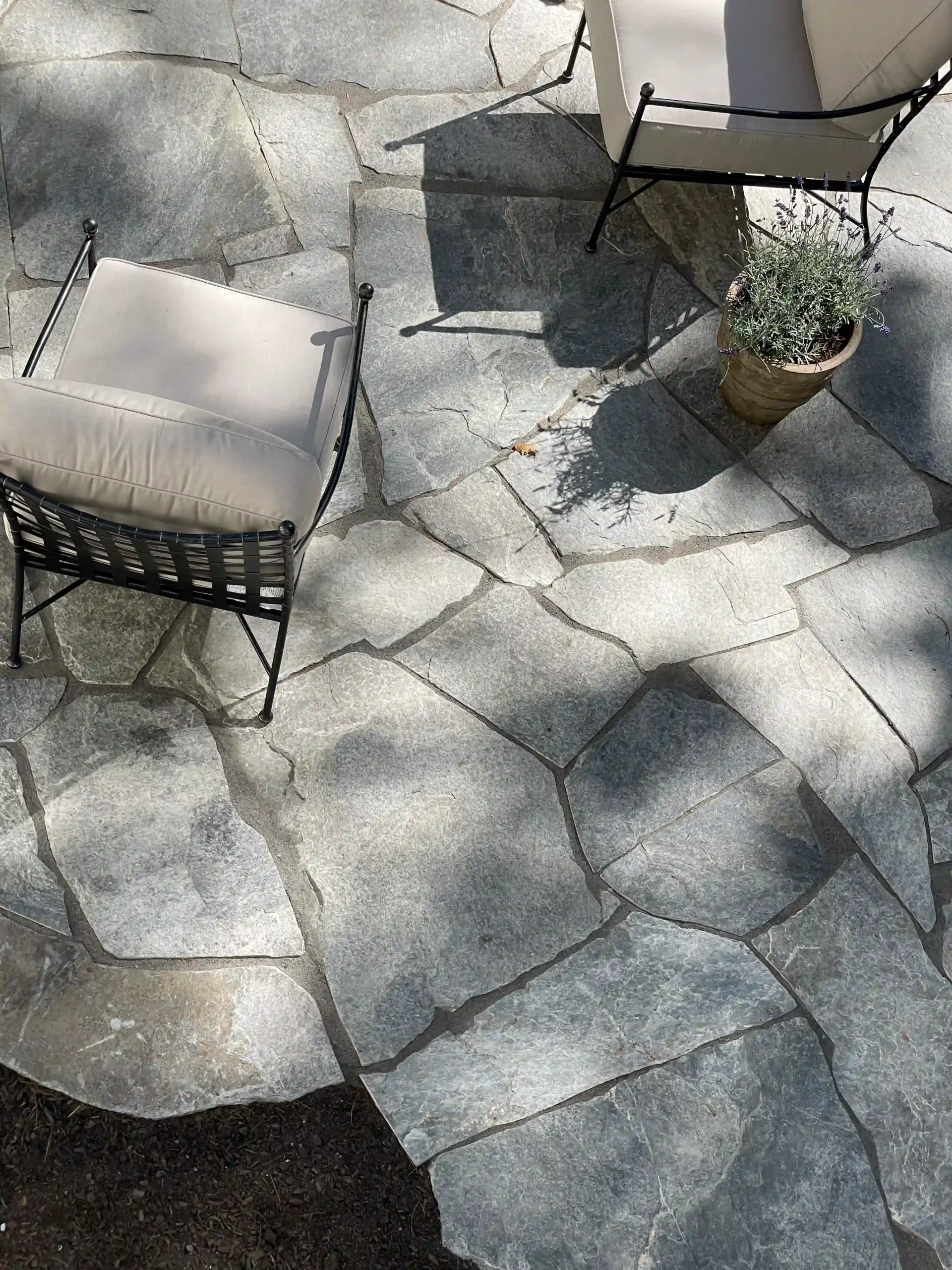
The Maine Cape’s back patio is quite large – roughly 16 feet in diameter. Due to the larger size, the scale of the flagstones needed to correlate. We chose stand-up flagging that was roughly 3-4 feet in diameter. Any larger, and we wouldn’t have been able to move the flagstones ourselves. Any smaller, and the patio would have looked too busy.
For this project, we dug down where the patio was going to be, laid landscape fabric, poured a gravel base, packed it well, and then laid the flagstones on top. We opted for a tighter installation, with 1 inch joints in most spots. With such small gaps, you need to cut and custom fit most stones into place. For the joint filler, we chose gray polymeric sand, which hardens after getting wet, almost like grout.
PROS:
- The large flagstones work well for patios – creating a more stable base for furniture, pots, and walking.
- Large stones reduce visual clutter. Fewer joints = less busy.
- Small joints are better for patios – creating a stable base for furniture, pots, and walking.
- The packed gravel base allows you to perfectly level the stones and slope the patio, allowing water to shed away from the house.
- The polymeric sand is the ideal low-maintenance filler. It’s easy to install, doesn’t spread, and prevents weeds from growing through. It works best when the joints are 1 ½ inches wide or less.
CONS:
- Hard installation. I would not classify this as a DIY project. The stones are quite heavy and require a lot of muscle (or equipment) to move them.
- Cutting most of the stones to fit in place requires a lot of time and planning.
The patio turned out beautiful, and there’s very little I would change about it. If we had the opportunity to use 5-6 foot wide flagstones, I think I would have. But again, that would have required equipment to move them. We had a long and cold winter, so there are some spots where the Polymeric sand settled. This is normal, and after a second application, we shouldn’t experience this again for quite some time.
All in all, this installation method is hard, but absolutely beautiful. It’s the ideal route for a large patio, and if installed correctly, it will last for many years to come!
Leave a Reply
Where behind the scenes, exclusive advice, and candid conversations are sent straight to your inbox every week.
The Inside Scoop
DO YOU WANT

I would love a flagstone patio. It has so much character over my current boring cement patio. If I ever inherit some money, that would be the first place I’d spend it.
I love your current walkway also. It’s so perfect for your house.