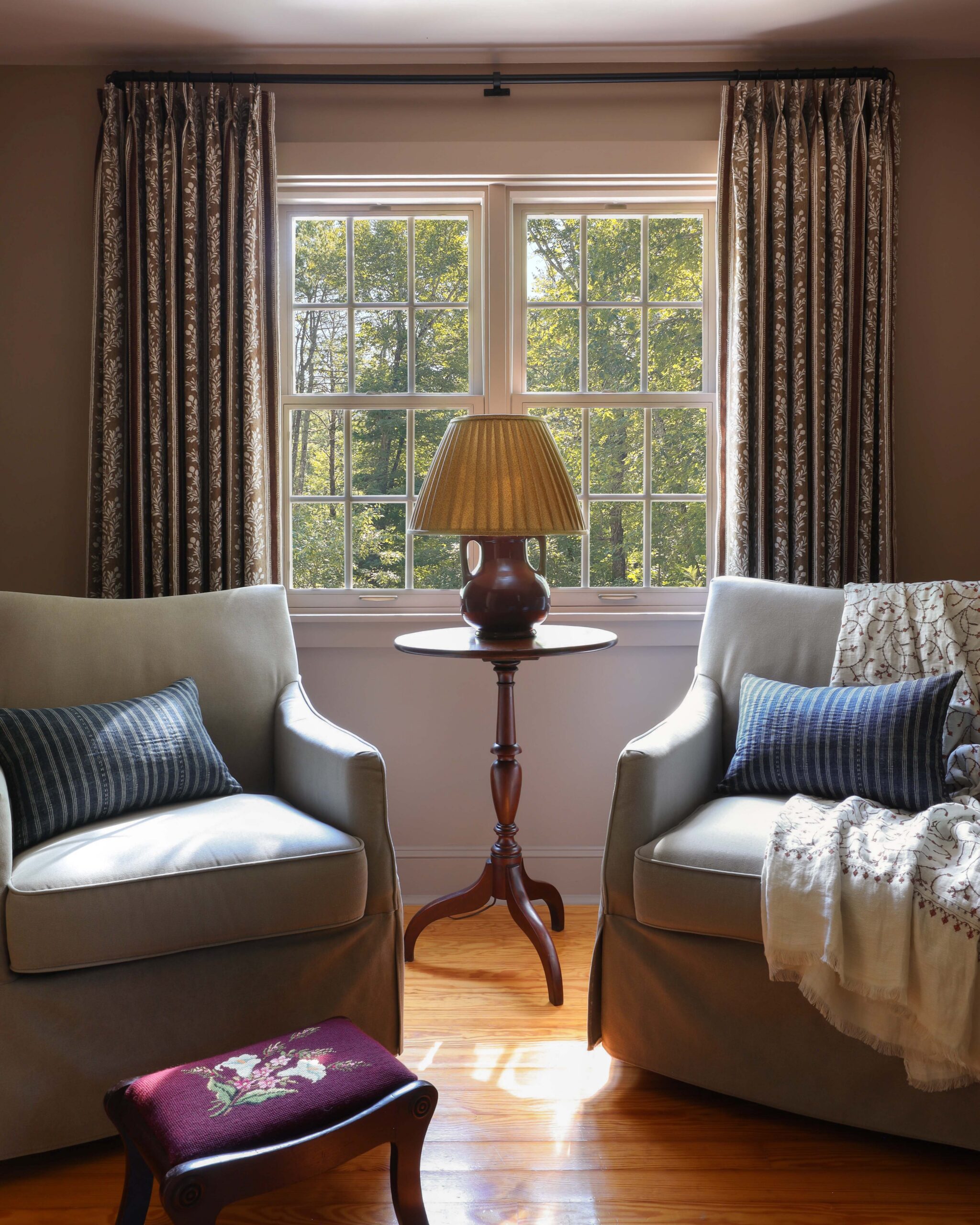

Ordering custom curtains can feel a little overwhelming when you’re not familiar with the language. The stack width, lining, header style, and memory shaping are just as important as the fabric. In our guest bedroom, I worked with FreShine to create my ideal pinch-pleated curtains, and I thought I’d break down exactly what I request when ordering made-to-measure curtains.
This post is sponsored by FreShine and contains affiliate links.

When I started searching for curtains for the guest bedroom, I knew it was going to take some time. I had a vision of a deep burgundy or plum woven fabric with florals or stripes and pinch pleats. Finding fabric that matched the picture in my head proved to be quite difficult, and I was prepared to sew my own. That is, until I found the perfect curtains.
I was introduced to FreShine and was immediately drawn to their jacquard curtains. The patterns are woven with the fabric rather than printed. That, in combination with their chenille fabric, gave me the thickness and texture I was hoping for. I ordered a few fabric samples, and I was most intrigued by this Sariel beige & brown fabric. But I was craving more depth. Then I flipped the fabric over, and it was love at first sight. The deep burgundy backdrop highlights the white floral band and burgundy stripes. It’s exactly the type of pattern and color I wanted, and FreShine was so kind to accommodate my request! If there’s one thing you take away from this article, it’s that you should never discount the *back* of fabric.


My Go-To Custom Curtain Specs
When ordering custom curtains, these are my go-to specs:
Header Type:
Definition: The top 4-6 inches of a curtain where the fabric is pleated, gathered, or sewn flat. See header styles here.
I prefer a double pinch-pleated header for most settings. A triple pinch-pleat is beautiful in formal rooms, and a tailor pleat (also called a euro pleat) is a great choice for modern spaces. The taller the curtains, the bigger the header should be. I prefer a 4″ header for rooms with 8-foot ceilings and a 6″ header for rooms with 10-foot ceilings.
Number Of Panels:
I always use 2 panels for one window. Symmetry is a requirement in my mind.
Lining:
Definition: An extra layer of fabric sewn on the back side of curtains to provide structure, privacy, and block light.
I prefer unlined curtains. A white or black liner can look unsightly from the outside. If you prefer to block more light, consider doubling the fabric instead of adding a liner. (Note: The FreShine jacquard fabric is very thick and blocks most light on its own.)

Memory Shaping:
Definition: A heat-setting process that trains the fabric to maintain crisp pleats and uniform folds. It helps your curtains hang beautifully from day one.
When possible, I like to have the workroom memory shape the curtains so they hang neatly. You can train them yourself at home, but it does require some time and effort.
Measurements:
Use FreShine’s measurement tool to determine the right curtain height and width for your windows. For curtains hung with rings on a rod, install your rod and rings first, then measure.
Rod Placement: I like to hang the curtain rod 8-12 inches past the window casing. This gap is known as a stack width and allows your curtains to drape neatly when open. In most cases, I recommend hanging the rod around 3-5 inches below the ceiling. If you have 10 ft+ ceilings but your windows are still standard height, hang the rod 8-12 inches above the window casing instead. Read more about curtain rod placement here.
Curtain Width: To ensure your curtains have ample fullness (i.e. the curtains fully cover the window and have plenty of ripples even when pulled shut), measure the full length of your curtain rod, not the window. Pleated curtains (which I recommend) require extra fabric. For double pinch-pleated or double tailor pleated curtains, request 2x fullness. For triple pinch-pleated or triple tailor pleated curtains, request 2.5x fullness.
For example: my curtain rod is 87 inches wide. I requested 2 panels with double pinch pleats and 2x fullness. An 87-inch fabric width covers approximately 44″ when pleated with 2x fullness. So I ordered 2 panels at 87 inches wide. I know this can be confusing, so I recommend utilizing FreShine’s measurement tool because it calculates fullness and width for you!
Curtain Length: Measure from the bottom of the curtain ring’s “eye” (i.e. where the curtain hooks onto the ring) to your desired stopping point. In most cases, I prefer curtains that “kiss” the floor, so measure from the ring’s eye to the floor.

These are my go-to specs when ordering custom curtains, and I love how tailored they turn out. Curious what other curtains I had my eye on for the guest bedroom? Sharing a few I love below –
Pleated Curtains I Love
SCROLL RIGHT TO VIEW THE FULL LIST →
Where behind the scenes, exclusive advice, and candid conversations are sent straight to your inbox every week.
The Inside Scoop
DO YOU WANT