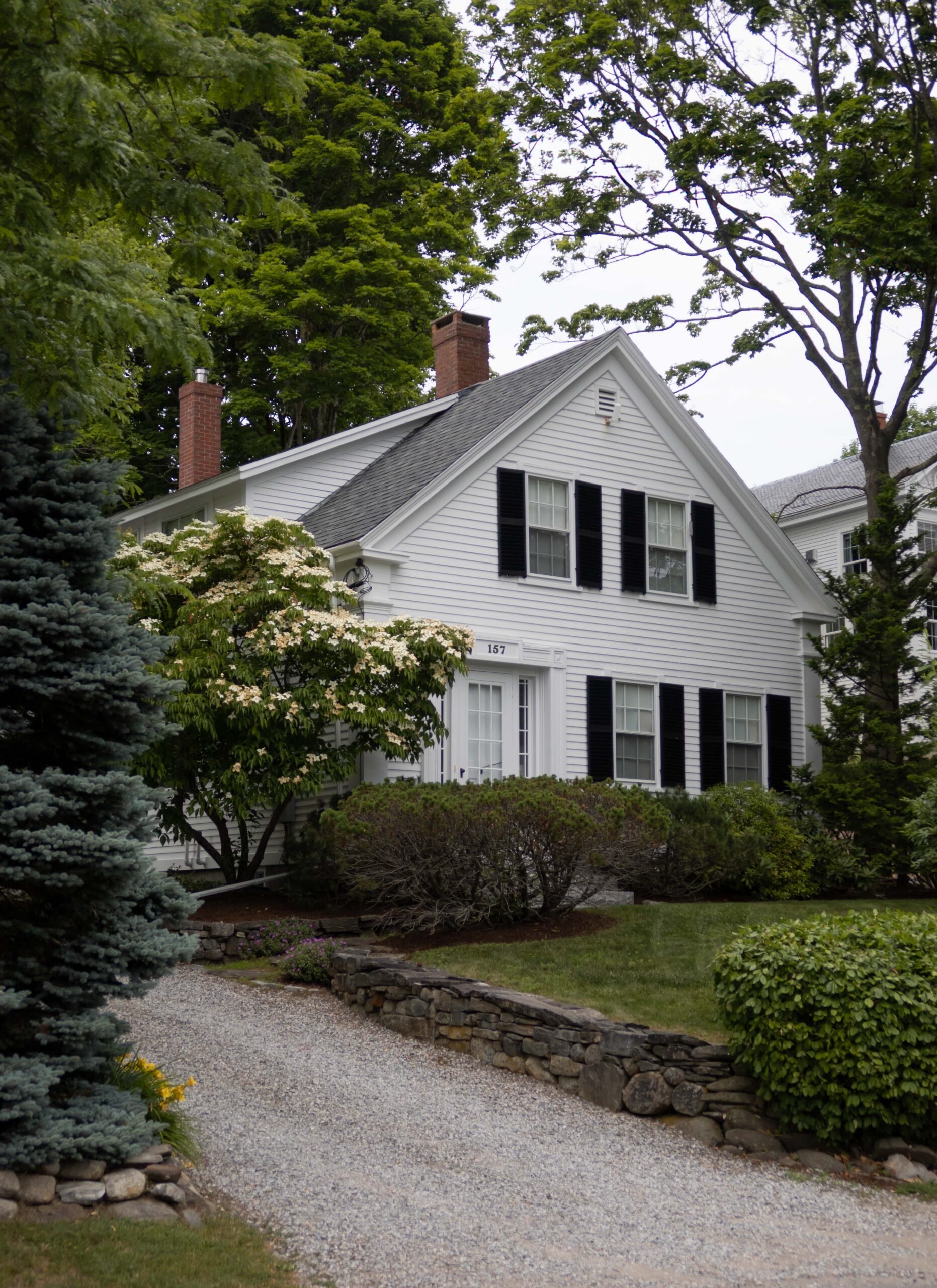

Lately, I’ve been talking in depth about historic architecture: how poverty played a big role in preservation, ideal millwork dimensions, the evolution of moulding profiles, and window styles by architecture. The more time one spends studying old homes, the more one notices the delicate details and how they’ve morphed over time. One exterior element that has evolved is shutters. What once served a functional purpose has since become merely decorative.
Today, decorative shutters are a standard feature on many homes, but shutters were originally intended to provide protection during storms, privacy, security, and light control. While the practical need for shutters has lessened, many still appreciate the charm they add to a home. And since fake shutters are more affordable, accessible, and easier to install than functional shutters, faux alternatives have become the go-to option. This begs the question: are fake shutters a stylish alternative or a design mistake?


A Case For Decorative Shutters
*To clarify, when I say decorative or fake shutters, I’m referring to non-functional, wood or plastic shutters that are permanently attached to a home’s exterior.
I greatly appreciate it when homeowners and builders value a home’s aesthetic enough to install shutters. This is an unnecessary additional cost that is strictly for looks. We’re in a time where new homes are often stripped of all character and ornamentation, so I’m grateful when there is an attempt to boost curb appeal. Functional or not, shutters add charm. That said, decorative, or fake shutters look strange if not chosen wisely. Keep reading to see what I mean…
The Issue With Fake Shutters
Where fake shutters fall short is their lack of acknowledgment for their intended use. Real shutters are mounted on hinges, and each one is half the width of the window. When pulled shut, the pair covers the entire window. Decorative shutters, on the other hand, are permanently fixed to the house. They’re usually narrower than the overall width of the window, and if they were able to swing shut, they wouldn’t fully cover the window. It looks odd and distracting to see a narrow shutter next to a large window.
One of the most common mistakes I see is fake shutters flanking paired or bay windows, despite being far too narrow to cover the opening. Often, the reasoning is simple: if every other window on the house has shutters, it feels natural to give these windows the same treatment. The problem is that fake shutters are rarely sized to fit larger windows. They immediately reveal themselves as purely decorative rather than authentic architectural features.
Take the home below for example. The shutters are far too narrow for the paired windows.

I rarely recommend decorative shutters, but if you must, follow these two tips to disguise the fact that they’re fake:
- Choose a width that is equal to the size of the window.
- Don’t leave a gap between the window and the shutter. If you notice, functional shutters are mounted on the inside of the window casing. The bigger the gap you leave, the more obvious it becomes that the shutters are fake.
Keep in mind, however, that if your windows are wide or paired side-by-side, shutters of proportionate size may look too big. If your home has a variety of window sizes with little symmetry, an assortment of shutter widths will also look odd. Forgoing shutters entirely may be a better option in these cases.

The Best Option Is Always Functional Shutters
Decorative shutters have been stripped of their purpose and merely suggest authenticity rather than provide it. Because of this, I always prefer real, functional shutters. Wood shutters with hinges ground a home in history and purpose. They add significantly more charm than fake alternatives, and they age with a kind of authenticity that manufactured ones can’t replicate. In fact, I would offer grace to a home that has functional shutters, even if one set is too narrow for a paired or bay window. (Like the home below) The functionality of shutters plays *that* big of a role in the design.
Functional shutters prove that the most beautiful architectural details are the ones designed to do something, not just look like they do.
Remember, choose a shutter width that matches the size of your windows and use iron hardware for an extra layer of authenticity. Sharing a few hardware shops I recommend below –

Where To Source Shutter Hinges, Hooks, & Holdbacks
There are a few companies that offer quality iron hardware for shutters:
- Historic Housefitters – I’ve purchased from this company many times. Their products are exceptional quality and the owners are incredibly wonderful!
- Acorn – A great variety of hinges and holdbacks of great quality
- House Of Antique Hardware – Known for their impressive selection of reproduction antique hardware.
- Lynn Cove – A stunning collection of hinges, holdbacks, hooks, bolts, and pulls.
Leave a Reply
Where behind the scenes, exclusive advice, and candid conversations are sent straight to your inbox every week.
The Inside Scoop
DO YOU WANT

I don’t know how it is in the USA but in Europe shutters do play a role and are important to keep the right temperature inside the houses. With the last heatwaves this and in past summers, shutters are key to protect from direct sun keeping the inner space fresh. In winter they help maintaining the heat inside specially at nights when the temperatures drop. I started saying that I don’t know how it is in the USA, but in a warming planet real shutters might become important in your houses too.
Many years ago I learned you don’t put shutters on windows that are wider than they are tall. Now when I walk my neighborhood & see it being done incorrectly I can’t help but shake my head.